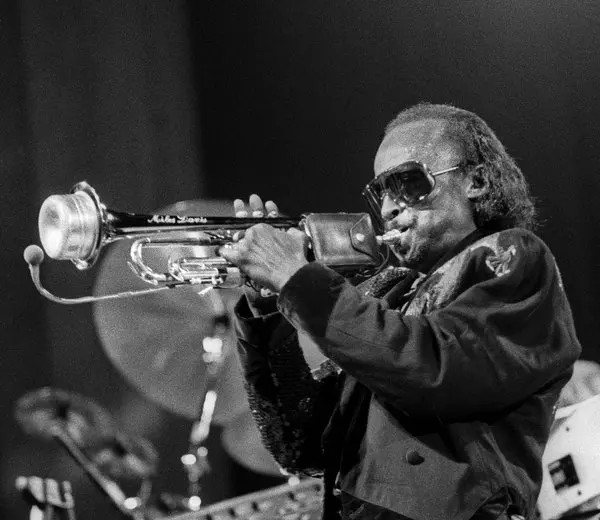
The Heretic’s Horn
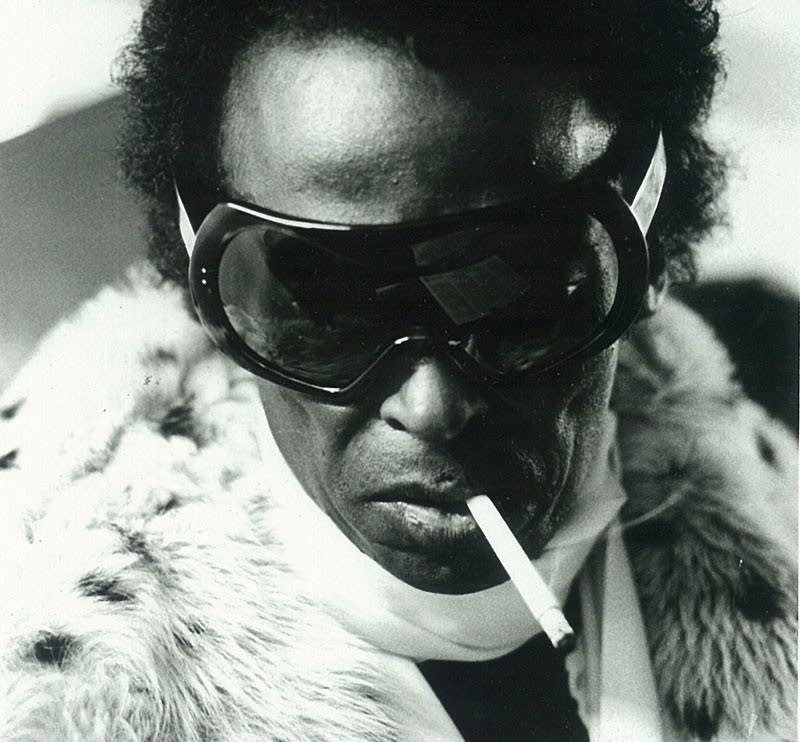
In 1964, a young trumpeter named Wynton Marsalis was born in New Orleans. He would grow up to become the most vocal defender of jazz orthodoxy the music has ever produced — the man who would declare, with the certainty of a papal edict, that Miles Davis’s electric period was not jazz, was not art, was not anything worth preserving. By the time Marsalis ascended to his position as jazz’s de facto cultural arbiter in the 1980s, the verdict among the traditionalist establishment had already been rendered: somewhere around 1969, Miles Davis had lost his mind, betrayed his gift, and sold his trumpet for a wah-wah pedal and a bag of rock-and-roll tricks.
The story the purists told was simple and satisfying. The greatest trumpeter in jazz history — the man who had been present at the birth of bebop, who had invented cool jazz, who had made Kind of Blue, the single most revered album in the entire idiom — had simply given up. Seduced by commercial ambition, intoxicated by the counterculture, corrupted by white rock audiences and their money, Davis had abandoned everything that made his music great. He replaced acoustic instruments with electric ones. He replaced swing with funk grooves. He replaced improvisation with studio manipulation. He replaced jazz with something else — something the purists could not name without spitting.
This is not that story.
This is the story of what actually happened between 1969 and 1975, when Miles Davis — already forty-three years old when the decade began, already a giant who had remade jazz four times over — chose to remake it a fifth time, at greater personal and professional cost than any of his previous reinventions. It is the story of a musician who heard the future in the sounds of Sly Stone, Karlheinz Stockhausen, and James Brown; who understood that jazz was dying of its own respectability; who dragged the music kicking and screaming into collision with the entire sonic world, and was exiled for his trouble. And it is the story of why that exile was, in the end, the proof that he was right.
I. The End of the Second Great Quintet (1968)
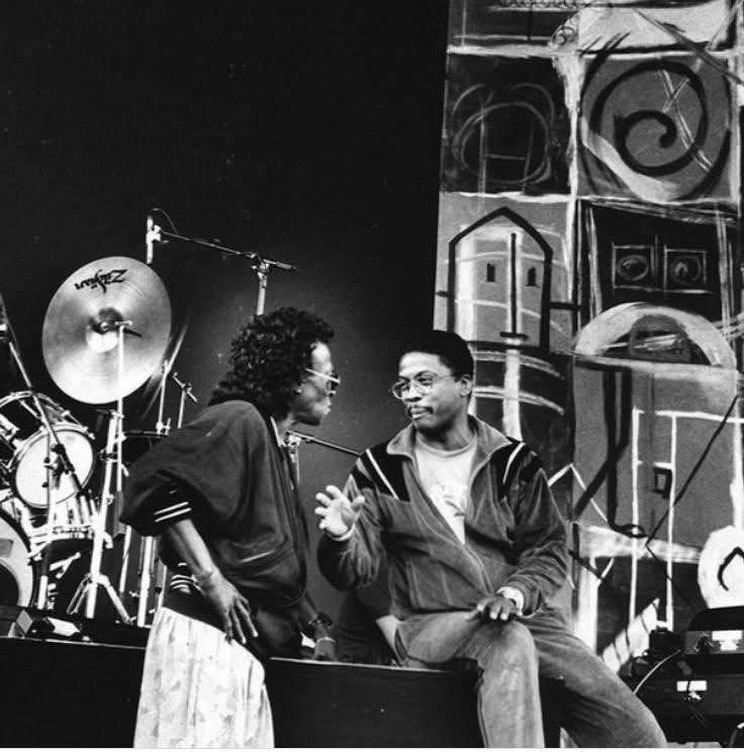
By 1968, Miles Davis was leading the finest small group in jazz history. His second great quintet — Wayne Shorter on tenor and soprano saxophone, Herbie Hancock on piano, Ron Carter on bass, Tony Williams on drums — had spent four years dismantling the conventions of post-bop and rebuilding them into something wilder, more abstract, and more structurally radical than anything in American music. Albums like E.S.P. (1965), Miles Smiles (1966), and Nefertiti (1967) were not merely accomplished; they were revolutionary. The rhythm section played with a collective freedom that dissolved the traditional boundary between soloist and accompanist. Shorter’s compositions were labyrinthine. Williams, barely twenty years old, played drums as if time itself were a suggestion rather than a law.
And it was over.
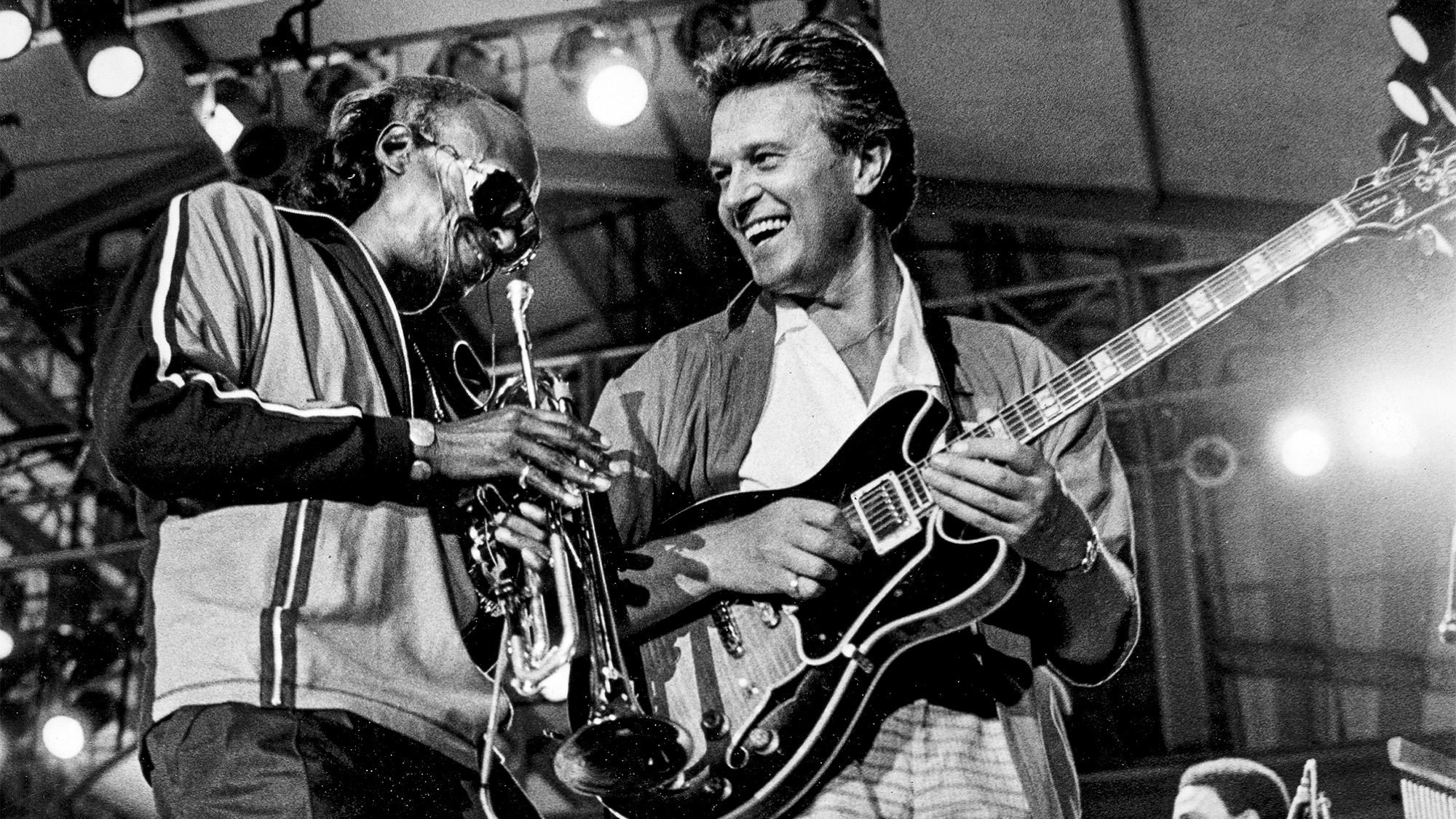
The fractures had been visible for a while. Hancock, drawn to funk and electronic textures, had formed his own band and was exploring the sounds that would become Mwandishi and Head Hunters. Williams, restlessly ambitious, had formed the Tony Williams Lifetime with guitarist John McLaughlin, playing music so loud and so aggressive that it made most jazz musicians physically uncomfortable. Carter, the most traditional of the five, was the only member whose musical instincts still aligned naturally with the band’s original purpose. Shorter, increasingly drawn to the soprano saxophone and to composing, was poised to leave for what would become Weather Report. Davis could feel the group dissolving around him.
But the dissolution was not merely personal. Something more fundamental was shifting in the culture. Jazz, which had once been America’s popular music, was now a museum piece — respected, studied, canonised, and increasingly ignored by the young black audience that had once been its lifeblood. By 1968, the radio belonged to James Brown and Sly Stone and Jimi Hendrix. The clubs belonged to rock bands. The streets belonged to funk. Jazz was being preserved to death, embalmed in the formaldehyde of critical approval, its audience ageing and shrinking with every passing year.
Davis saw this with the clarity of a man who had survived every transition jazz had undergone since bebop. He had been nineteen when he played with Charlie Parker. He had been twenty-two when he led the Birth of the Cool sessions. He had been thirty-three when he made Kind of Blue. He had remade himself — and remade the music — every time the old forms stopped breathing. And now, at forty-two, he could feel the air thinning again. The question was not whether to change. The question was what to change into.
The answer was already in the room. Miles in the Sky (1968) had featured Hancock on electric piano for the first time. Filles de Kilimanjaro (1968), recorded in two sessions that June and September, went further: electric piano on every track, a rock-inflected rhythmic sensibility, and — crucially — the replacement of Ron Carter with Dave Holland, a young British bassist who could play both acoustic and electric. The album’s opener, “Frelon Brun,” was built on a driving rock pulse. Its closer, “Petits Machins,” rode a groove that owed more to Memphis than to Manhattan.
These were not acts of desperation. They were acts of attention — the same attention that had led Davis to Gil Evans in 1957, to modal jazz in 1958, to the post-bop abstraction of the second quintet in 1964. Davis was listening. And what he heard, everywhere around him, was electricity.
II. In a Silent Way: The Door Opens (February 1969)
On 18 February 1969, Miles Davis walked into CBS 30th Street Studio in Manhattan with a band that would have been unimaginable two years earlier. Three keyboard players — Chick Corea and Herbie Hancock on electric piano, Joe Zawinul on electric piano and organ — sat alongside Wayne Shorter on soprano saxophone, the newly arrived John McLaughlin on electric guitar, Dave Holland on double bass, and Tony Williams on drums. Eight musicians. Three electric keyboards. One electric guitar. A trumpet. A rhythm section that was half-acoustic, half-electric. It was the most improbable ensemble Davis had ever assembled, and he had no idea what they were going to play.
This was characteristic. Davis’s method during the electric period was not to compose in any conventional sense. He brought sketches — chord fragments, melodic hints, rhythmic suggestions — and directed the musicians in real time. He told them what to feel rather than what to play. McLaughlin, who had been in the United States for less than two weeks when Davis called him for the session, later recalled his terror at the prospect of recording with his idol. Davis’s advice was characteristically oblique: play the guitar as if you were a novice. Strip away everything you know. Start from zero.
What emerged from the three-hour session was raw material — hours of improvisation built around a few harmonic anchors and Davis’s live direction. Then came the edit. Producer Teo Macero, working with Davis, took the recorded takes and sculpted them into shape using techniques drawn from classical sonata form and the avant-garde tape experiments of composers like Edgard Varèse and Vladimir Ussachevsky, both of whom Macero had worked with in the 1950s. Sections were spliced, repeated, reordered. The opening and closing of each track used the same thematic material, creating an ABA structure — exposition, development, recapitulation — that was not performed in the studio but constructed afterward, from fragments.
The result was In a Silent Way, released on 30 July 1969: two extended compositions, each occupying one side of the LP, each built around a meditative electric groove that pulsed and shimmered without ever resolving into anything as crude as a hook. “Shhh/Peaceful” was Davis’s own composition — a single chordal area sustained for eighteen minutes, with soloists floating in and out of the texture like spirits through fog. “In a Silent Way/It’s About That Time” was built from Zawinul’s atmospheric title piece, which Davis stripped to its bare melodic bones, rearranging it around a pedal point and a rock-inflected pulse that Zawinul himself reportedly disliked. Davis later admitted that Zawinul was “never happy” with the adaptation, but felt the album would have been less successful had its original arrangement been kept.
The critical reaction was bifurcated along the precise fault line that would define the next six years of Davis’s career. Rock critics heard something they recognised — or thought they did. Lester Bangs, writing in Rolling Stone, called it “the kind of album that gives you faith in the future of music,” describing it as “part of a transcendental new music which flushes categories away.” Jazz critics heard betrayal. Phil Freeman, in his book Running the Voodoo Down, captured the divide precisely: “Rock critics thought In a Silent Way sounded like rock, or at least thought Miles was nodding in their direction, and practically wet themselves with joy. Jazz critics, especially ones who didn’t listen to much rock, thought it sounded like rock too, and they reacted less favourably.”
But both reactions were wrong. In a Silent Way was not rock. It was not jazz. It was not the genre that would come to be called fusion. It was something altogether different — a music that existed in the negative space between categories, that owed as much to the studio as to the musicians, that was as much Macero’s creation as Davis’s. Freeman, reflecting on this, wrote that it was “the sound of Miles Davis and Teo Macero feeling their way down an unlit hall at three in the morning. It was the soundtrack to all the whispered conversations every creative artist has, all the time, with that doubting, taunting voice that lives in the back of your head, the one asking all the unanswerable questions.”
The door was open. What lay beyond it was considerably darker.
III. Bitches Brew: The Explosion (August 1969)
Six months later, Davis returned to the studio — this time Columbia’s Studio B on 52nd Street — with an even larger ensemble. Where In a Silent Way had used eight musicians, Bitches Brew would employ as many as thirteen at once. The core working band of Shorter, Corea, Holland, and Jack DeJohnette was augmented by Zawinul, McLaughlin, Herbie Hancock, Larry Young on electric piano, Harvey Brooks on electric bass, Lenny White and Billy Cobham on drums, Don Alias and Juma Santos on percussion, and Bennie Maupin on bass clarinet. The logistics alone were radical. Three keyboardists. Two bassists. Two or three drummers playing simultaneously. A percussionist. A guitarist. A soprano saxophonist. A bass clarinettist. And Miles Davis, standing in the middle, conducting with his trumpet and his voice.
The sessions ran from 19 to 21 August 1969 — three days, ten a.m. to one p.m., all live recording, no overdubs. Lenny White later described the set-up: “It was like an orchestra, and Miles was our conductor. We wore headphones. We had to be able to hear each other. There were no guests at that session. No photos allowed.” Davis gave minimal instructions: a tempo count, a few chords, a hint of melody, suggestions as to mood or tone. On the quieter passages of the title track, his voice is audible on the recording — snapping his fingers to indicate tempo, telling the musicians to “keep it tight”, directing individuals when to solo. “John,” he says at one point, cueing McLaughlin. The music was being born in real time.
Then came the edit. If In a Silent Way had introduced Macero’s tape manipulation as a compositional tool, Bitches Brew weaponised it. “Pharaoh’s Dance” contains nineteen edits — its stop-start opening is entirely constructed in the studio, using repeat loops of certain sections. Later in the track, micro-edits are deployed: a one-second fragment that first appears at 8:39 is repeated five times between 8:54 and 8:59. The title track contains fifteen edits, again with short tape loops. As Paul Tingen documented, Davis and Macero “used the recording studio in radical new ways, especially in the title track and the opening track, ‘Pharaoh’s Dance’. There were many special effects, like tape loops, tape delays, reverb chambers and echo effects. Through intensive tape editing, Macero concocted many totally new musical structures that were later imitated by the band in live concerts.” Macero, classically trained, was most likely inspired by the musique concrète experiments of 1950s and 1960s French composers. He used tape editing not as repair but as composition — as a form of arranging that was itself a creative act, separate from and equal to the musicians’ improvisations.
The rhythmic innovation was even more fundamental. The rhythm section — two bassists, two or three drummers, two or three electric piano players, and a percussionist, all playing simultaneously — created a density of pulse that was unprecedented in jazz. As Paul Tanner, Maurice Gerow, and David Megill explained, “like rock groups, Davis gives the rhythm section a central role in the ensemble’s activities. His use of such a large rhythm section offers the soloists wide but active expanses for their solos.” The harmonies moved slowly, functioning modally rather than tonally. The result was a music that flowed from “basic rock patterns to hard bop textures, and at times, even passages that are more characteristic of free jazz.” It was not a groove. It was an ecosystem — a teeming, saturated environment in which soloists functioned less as heroes than as organisms, adapted to their surroundings, feeding off the rhythmic and harmonic nutrients that the ensemble provided.
Released on 30 March 1970, Bitches Brew peaked at number 35 on the Billboard 200 — Davis’s highest-charting album to date. It won the Grammy Award for Best Large Jazz Ensemble Album in 1971. It was certified gold by 1976 and platinum by 2003. It topped the DownBeat critics’ poll in 1970. And it was loathed.
The jazz establishment’s response was visceral. Bob Rusch, the jazz critic and producer, recalled: “This to me was not great Black music, but I cynically saw it as part and parcel of the commercial crap that was beginning to choke and bastardise the catalogues of such dependable companies as Blue Note and Prestige.” Donald Fagen, the rock and jazz musician, was even more blunt: “Essentially just a big trash-out for Miles… To me it was just silly, and out of tune, and bad. I couldn’t listen to it. It sounded like he was trying for a funk record, and just picked the wrong guys. They didn’t understand how to play funk. They weren’t steady enough.”
The word “steady” is doing important work in Fagen’s criticism. It reveals the misunderstanding at the heart of the purist objection. Bitches Brew was not trying to be steady. It was not trying to be funk in any sense that James Brown would recognise. It was trying to be something that did not yet have a name — a music of collective improvisation over electric grooves, shaped by studio technology, structured by post-production rather than pre-composition. The complaint that it “didn’t swing” was literally true and entirely irrelevant. The complaint that it was “commercial” was contradicted by the music’s actual sound: this was not music designed to please anyone. It was music designed to expand — to test the limits of what a recording could contain, what an ensemble could sustain, what a listener could tolerate.
The Penguin Guide to Jazz captured this paradox with precision, calling Bitches Brew “one of the most remarkable creative statements of the last half-century, in any artistic form. It is also profoundly flawed, a gigantic torso of burstingly noisy music that absolutely refuses to resolve itself under any recognised guise.”
That refusal to resolve was the point. Davis had identified the central problem of late-1960s jazz: it had become a music of resolution, of neat conclusions, of harmonic closure. Everything ended where it was supposed to. The drama was in how you got there, not in whether you arrived. Bitches Brew abandoned arrival. It was a music of perpetual becoming — a brew that never settled, that kept reacting with itself, that generated new compounds faster than the old ones could crystallise.
IV. The Front Line: Jazz at War with Itself
The vilification of Miles Davis’s electric music was not merely aesthetic. It was cultural, generational, and — in ways that the critics themselves often did not articulate — racial.
Jazz in the late 1960s was caught in an identity crisis that went far deeper than questions of instrumentation. The music had been born in black communities, shaped by black experience, powered by black innovation. But by the late 1960s, its institutional infrastructure — the clubs, the labels, the magazines, the critics, the grants, the festival bookers — was overwhelmingly white. And the audience that still paid for jazz records was increasingly white, affluent, and middle-aged. The young black audience that had once sustained the music had migrated to funk, soul, and rock — music that reflected the rhythms and energies of their actual lives rather than the rarefied atmosphere of the jazz club.
Davis understood this with a clarity that his critics did not. When he told Melody Maker in 1972, “I don’t care who buys the record so long as they get to the black people so I will be remembered when I die. I’m not playing for any white people, man. I wanna hear a black guy say ‘Yeah, I dig Miles Davis,’” he was not posturing. He was describing a genuine artistic purpose — a desire to reconnect jazz with the black popular audience from which it had become estranged. The electric instruments, the funk grooves, the rock energy — these were not concessions to commercialism. They were attempts to speak the language of the present rather than the language of the museum.
The irony is that the jazz establishment — which presented itself as the guardian of authentic black musical tradition — was, in this instance, the force enforcing cultural isolation. The demand that Davis continue to play acoustic jazz for a predominantly white audience of connoisseurs was, itself, a form of commodification: the packaging of black artistic innovation as heritage product for a market that valued the music precisely because it was no longer popular with the community that created it.
Gil Evans, the arranger who had collaborated with Davis on Miles Ahead, Porgy and Bess, and Sketches of Spain, stated the case with devastating simplicity: “Jazz has always used the rhythm of the time, whatever people danced to.” This was not a radical proposition. It was a description of what jazz had always been — from the ragtime that underpinned New Orleans playing, through the swing that defined the big band era, to the bebop revolution that absorbed the rhythmic innovations of African-American popular music in the 1940s. Davis was doing what jazz musicians had always done: incorporating the sounds of the street into the language of art. That the street now sounded like amplifiers and drum kits rather than brass bands and stride piano was not Davis’s crisis. It was the critics’.
V. Jack Johnson and the Funk Pivot (1971)
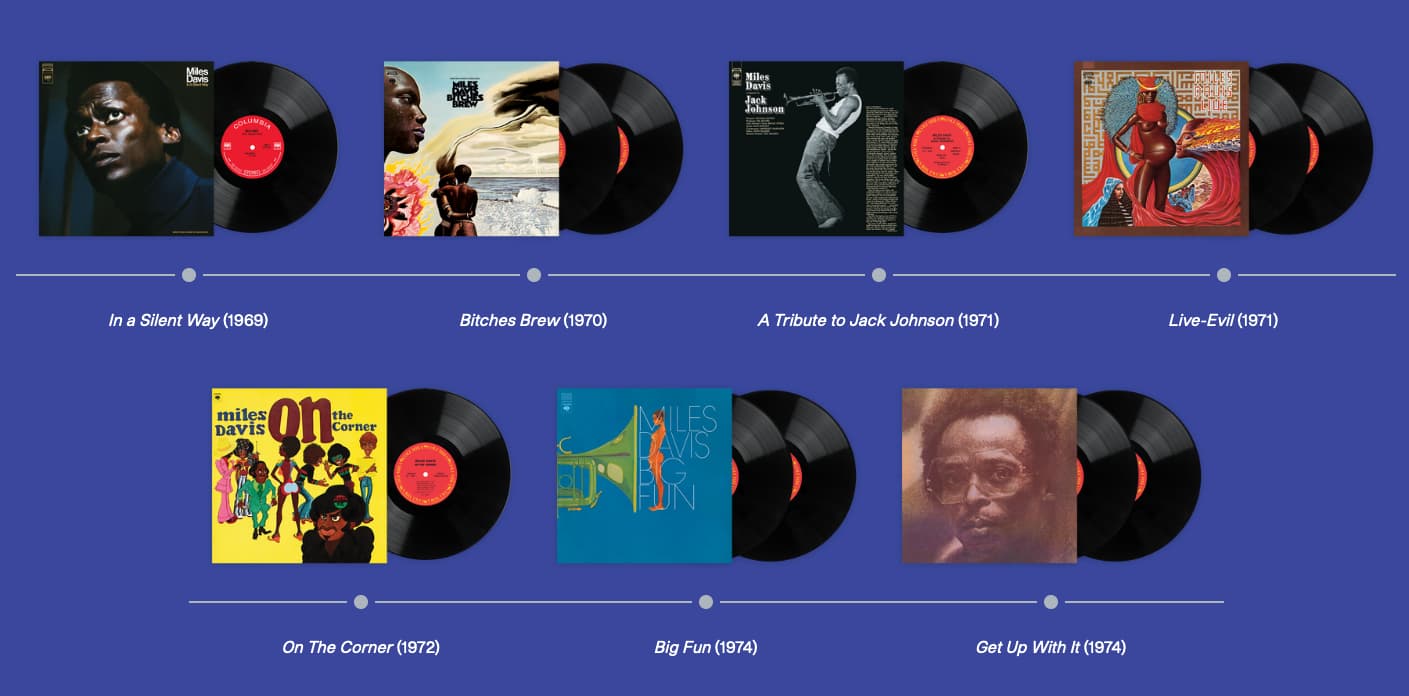
If Bitches Brew was the explosion, A Tribute to Jack Johnson (1971) was the afterburn. Recorded in a single day — 7 April 1970 — the album was conceived as the soundtrack to a documentary about the black heavyweight champion who had defied white America’s racial codes in the early twentieth century. The subject matter was pointed: Jack Johnson was a black man who refused to be contained by the expectations of a hostile culture. The analogy to Davis’s own position was not subtle, and it was not meant to be.
Musically, Jack Johnson was Davis’s most explicit engagement with rock. Where Bitches Brew had layered multiple rhythm sections into a dense thicket, Jack Johnson stripped the ensemble down to a lean, driving quintet: Davis on trumpet, McLaughlin on electric guitar, Steve Grossman on soprano saxophone, Holland on electric bass, and DeJohnette on drums. The music was built on relentless, rocking vamps. McLaughlin’s guitar work — distorted, rhythmic, overtly blues-influenced — was the loudest and most rock-oriented element Davis had yet incorporated. The album opener, “Right Off,” rides a single groove for nearly twenty-six minutes, building intensity through repetition rather than development.
The editing was again radical. Macero spliced together sections from different takes, creating seamless transitions that the musicians had never played in sequence. The famous groove that opens “Right Off” — one of the most propulsive bass lines in Davis’s entire catalogue — was assembled from fragments. The music felt live and spontaneous, but much of its structure was post hoc, a collaboration between the musicians who played the material and the producer who shaped it.
The critical response was, by now, predictable. Jazz writers heard a capitulation to rock; rock writers heard a jazz musician playing at their genre. Neither camp grasped what was actually happening: Davis was not merging jazz and rock. He was using the energy and volume of rock as a structural element within a fundamentally jazz conception — improvisation over extended vamps, with the soloist as the central dramatic voice. The rhythm section was louder, but the logic was the same: create a dynamic environment, then let the soloist navigate it.
Jack Johnson sold poorly. It was the first sign that Davis’s electric experiments, whatever their artistic merit, were not reaching the audience he wanted. The young black listeners were not buying it. The jazz audience was not buying it. The rock audience was not buying it. Davis was making some of the most adventurous music of his career, and he was playing to a shrinking, divided constituency.
VI. On the Corner: The Most Vilified Album in Jazz History (1972)
By early 1972, Davis was ready to go further. On the Corner was conceived as a deliberate attempt to reach the young African-American audience that had abandoned jazz — an audience that danced to Sly Stone and James Brown, that lived in the funk, that had no use for a forty-six-year-old trumpeter playing abstract improvisations for seated white intellectuals. Davis told his producer, Teo Macero, that he wanted to make a record that sounded like the street.
What he made instead was the most controversial album in the history of jazz.
The recording sessions for On the Corner took place on 1 June, 6 June, and 7 July 1972, at Columbia’s 52nd Street studio. The personnel shifted constantly. The anchor was Michael Henderson, a young electric bassist who had been playing with Stevie Wonder — a musician with virtually no jazz background, recruited specifically for his funk feel. Around Henderson, Davis assembled and disassembled configurations of musicians: John McLaughlin on guitar, Chick Corea and Herbie Hancock on electric keyboards, Jack DeJohnette and Billy Hart on drums, Al Foster on drums, James Mtume on percussion, Dave Liebman and Carlos Garnett on saxophones, Bennie Maupin on bass clarinet, Khalil Balakrishna on electric sitar, Badal Roy on tabla, Collin Walcott on electric sitar, Paul Buckmaster on electric cello. Davis himself played trumpet through a wah-wah pedal — an effect that transformed his instrument from a voice of lyrical clarity into something electronically mangled, blurred, human-but-not-quite-human.
The conceptual framework was new. Davis had been introduced to the music of Karlheinz Stockhausen by Buckmaster earlier in 1972, and the German composer’s ideas about electronic sound processing and the construction of musical structures through processes of addition and subtraction resonated deeply. Davis reportedly kept a cassette recording of Stockhausen’s electroacoustic composition Hymnen in his Lamborghini Miura. He later wrote in his autobiography: “I had always written in a circular way and through Stockhausen I could see that I didn’t want to ever play again from eight bars to eight bars, because I never end songs: they just keep going on. Through Stockhausen I understood music as a process of elimination and addition.”
Davis applied these ideas to On the Corner by literally adding and subtracting instrumentalists throughout the recordings, creating a progressively changing soundscape. The result was what he described as “Stockhausen plus funk plus Ornette Coleman” — a reconciliation of contemporary classical music, the harmolodic theory of the avant-garde saxophonist he had once disparaged, and the relentless rhythmic pulse of black dance music. The album functioned, as jazz historian Robert Gluck later described it, on two layers: “a relatively static, dense thicket of rhythmic pulse provided by McLaughlin’s percussive guitar attack, the multiple percussionists, and Henderson’s funky bass lines, plus keyboard swirls on which the horn players solo. Segments of tabla and sitar provide a change of mood and pace. Aside from ‘Black Satin,’ most of the material consists of intense vamps and rhythmic layering.”
Davis played trumpet scarcely. The wah-wah pedal reduced his instrument to a textural element — a sound that bubbled up through the mix rather than soaring above it. The bass was the lead voice. The drums were the architecture. The solos were fragments, buried in the groove. The album’s packaging deliberately omitted musician credits, in an attempt to make the instruments less discernible to critics. “I didn’t put those names on On the Corner specially for that reason,” Davis later admitted, “so now the critics have to say, ‘What’s this instrument, and what’s this?’ … I’m not even gonna put my picture on albums anymore. Pictures are dead, man. You close your eyes and you’re there.”
The reaction was annihilating. Paul Tingen called it “the most vilified and controversial album in the history of jazz” — and the evidence supports the claim. Stan Getz proclaimed: “That music is worthless. It means nothing; there is no form, no content, and it barely swings.” The Jazz Journal’s Jon Brown wrote that “it sounds merely as if the band had selected a chord and decided to worry hell out of it for three-quarters of an hour,” concluding that “I’d like to think that nobody could be so easily pleased as to dig this record to any extent.” Eugene Chadbourne, writing in Coda, described it as “pure arrogance.” Critic Bill Coleman called it “an insult to the intellect of the people.” Ian MacDonald of the NME declared it “monumentally boring.” DownBeat gave it two stars out of five.
Commercially, it was Davis’s worst-selling album to date, peaking at number 156 on the Billboard 200. Columbia, which had no idea how to market a record that was simultaneously too avant-garde for funk audiences and too funky for jazz audiences, effectively abandoned it. As Tingen wrote, “predictably, this impenetrable and almost tuneless concoction of avant-garde classical, free jazz, African, Indian and acid funk bombed spectacularly, leading to decades in the wilderness. As far as the jazzers were concerned, it completed Davis’s journey from icon to fallen idol.”
But here is the thing about On the Corner: it was right. Not in the sense that the critics who hated it were factually incorrect about what they were hearing — they heard exactly what they described: repetitive, groove-based music with barely any trumpet, barely any melody, barely any of the elements that conventionally defined jazz. They were correct about the surface. They were wrong about the significance. What they were hearing — without knowing it — was the future.
VII. The Long Reckoning: On the Corner’s Legacy
The reappraisal of On the Corner has been one of the most dramatic reversals in music criticism. Where once it was the album that proved Davis had lost his mind, it is now recognised as perhaps the most prophetic recording of his career — a work that anticipated, by decades, developments in styles that did not yet exist when it was made.
Stereogum called it “one of the greatest records of the 20th Century, and easily one of Miles Davis’ most astonishing achievements,” noting its mix of “funk guitars, Indian percussion, dub production techniques, loops that predict hip hop.” Alternative Press named it an “essential masterpiece” that “represents the high water mark of his experiments in the fusion of rock, funk, electronica and jazz.” Fact characterised it as “a frenetic and punky record, radical in its use of studio technology,” adding that “the debt that the modern dance floor owes the pounding abstractions of On the Corner has yet to be fully understood.” The Vinyl Factory described it as “the great great grandfather of hip-hop, IDM, jungle, post-rock and other styles drawing meaning from repetition.”
John F. Szwed, writing in The Wire, captured the album’s paradoxical fate with precision: “Jazz musicians hated it, critics bemoaned Miles’s fall from grace, and since Columbia failed to market it as a pop record, it died in the racks. Even now, when Davis’s jazz rock recordings are being reissued to great acclaim, On the Corner remains lost in time. Still, this record might well be the most radical break with the past of all of Davis’s many breaks. Dense with rhythm and conceptually enriched with noises, his trumpet’s role mixed down to that of a journeyman, the melody reduced to recycled Minimalist patterns, Davis broke every rule enforced by the jazz police. Yet today… we hear that Davis was laying the foundations for drum ‘n’ bass, trip hop, Jungle, and all the other musics of repetition to come.”
The mark Fisher review of the 2007 Complete On the Corner Sessions box set in The Wire made the crucial observation: “The passing of time often neutralises and naturalises sounds that were once experimental, but retrospection has not made On the Corner’s febrile, bilious stew any easier to digest.” This is what distinguishes On the Corner from mere provocation. Provocations lose their power once the shock fades. On the Corner has not been absorbed. It has not been naturalised. It remains, half a century later, a difficult, strange, uncomfortable record — one that resists easy listening and refuses to sit comfortably within any genre. Its difficulty is not a flaw. It is a feature. It is the sound of a musician pushing past the point where the culture could follow, and waiting — for decades, as it turned out — for the culture to catch up.
AllMusic’s Thom Jurek went furthest, arguing that “the music on the album itself influenced — either positively or negatively — every single thing that came after it in jazz, rock, soul, funk, hip-hop, electronic and dance music, ambient music, and even popular world music, directly or indirectly.” This is a large claim. But the lineage is traceable: from On the Corner’s repetitive bass grooves and studio-assembled structures to the loop-based architectures of hip-hop; from its dense rhythmic layering and electronic textures to the collaged soundscapes of electronica and IDM; from its refusal of the soloist-as-hero model to the collective, groove-oriented aesthetics of post-punk and dance music; from its wah-wah trumpet and Indian percussion to the global fusion experiments of subsequent decades. The album did not cause these developments. But it prefigured them, with an accuracy that is, in retrospect, startling.
The mainstream jazz community, Tingen observed, “still won’t touch On the Corner with a barge pole” — and this, too, is part of the story. The album’s failure to find acceptance within jazz is not merely a matter of conservative taste. It reflects a fundamental disagreement about what jazz is — whether it is a tradition defined by its formal characteristics (swing, acoustic instrumentation, harmonic resolution, the primacy of the soloist) or a tradition defined by its method (improvisation, the incorporation of contemporary sounds, the rejection of stasis). Davis believed the latter. The establishment believed the former. On the Corner was the record on which that disagreement became irreconcilable.
VIII. The Final Bands: Cellar Door to Agharta (1972–1975)
After On the Corner, Davis made no more studio albums conceived as complete works. The rest of the decade’s studio output — Big Fun (1974), Get Up with It (1974) — consisted of session recordings assembled and released as compilations, often with tracks recorded years apart. The centre of gravity shifted decisively to live performance, where Davis’s bands became louder, denser, and more rhythmically extreme.
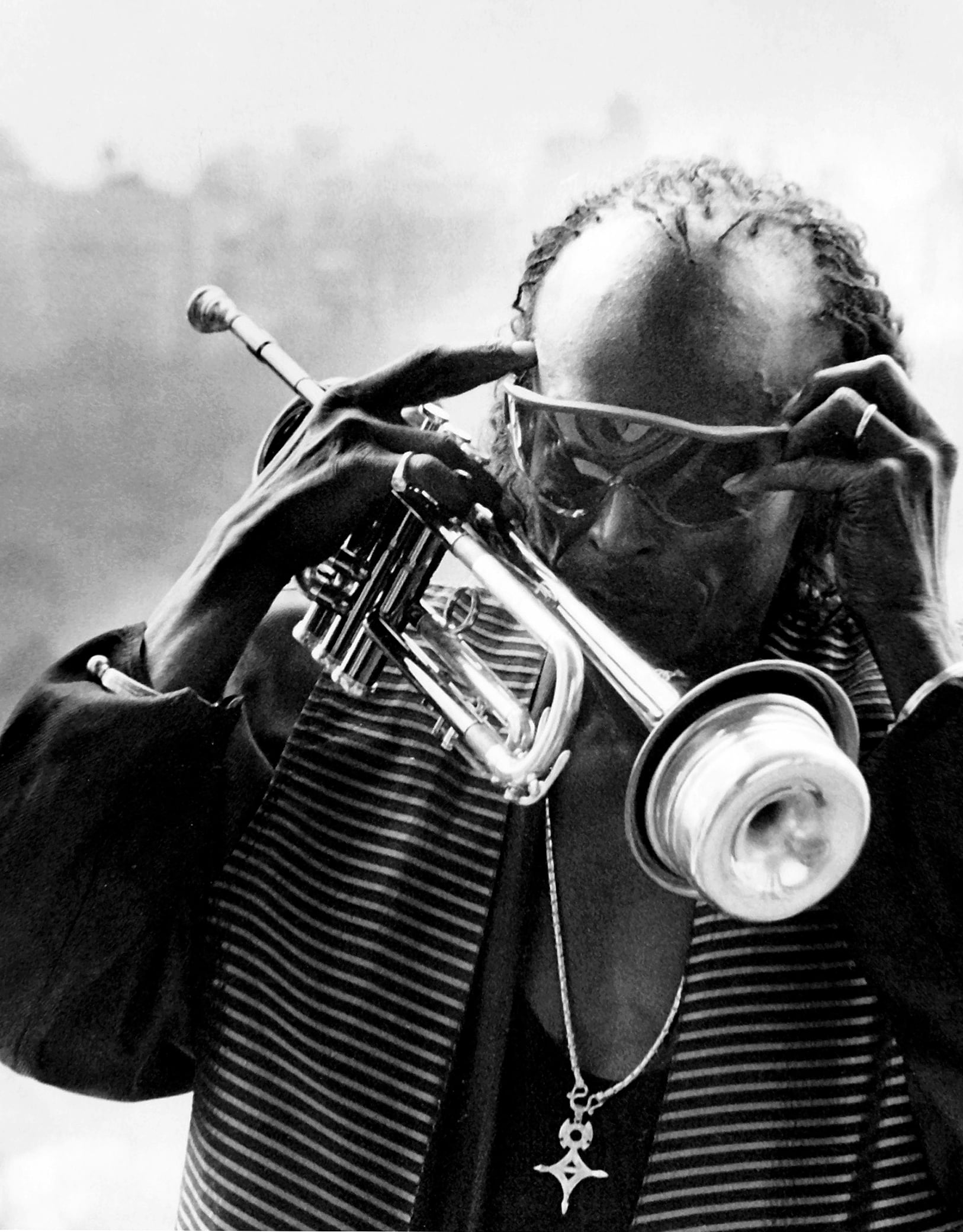
The live bands of this period were built around a core: Michael Henderson on electric bass, providing the funk anchor that Davis had identified as the essential foundation; Al Foster on drums, a musician whose feel for groove Davis described as the best he’d ever heard; Mtume on percussion, adding layers of rhythmic complexity; and a rotating cast of guitarists, keyboardists, and saxophonists who would enter and exit the music at Davis’s direction. The trumpet, increasingly processed through wah-wah and other effects, functioned as one colour among many rather than as the lead voice. Davis conducted more than he played — cueing entries, cutting off solos, directing the flow of the music with gestures and glances, occasionally stepping forward to deliver a burst of electronically distorted trumpet before retreating back into the ensemble.
The Cellar Door sessions in December 1970 — released decades later as The Cellar Door Sessions 1970 — captured a transitional moment, with Keith Jarrett on electric piano and John McLaughlin on guitar joining the core band. Jarrett, who would later become one of the most celebrated acoustic pianists in jazz, was audibly uncomfortable with the electric instrument, but his discomfort produced something interesting: a keyboard style that was sparser, more angular, more resistant to the groove than the playing of Corea or Hancock, creating a tension between the rhythm section’s momentum and the soloist’s reluctance that gave the music its distinctive edge.
By 1975, the live band had reached an extreme of density and volume that can be heard on Agharta and Pangaea, both recorded on 1 February 1975 at the Osaka Festival Hall in Japan. These are the final documents of Davis’s electric period — twin live albums, one performed in the afternoon (Agharta) and one in the evening (Pangaea), capturing a band that had evolved into something closer to a ritual than a concert. The music is overwhelming: waves of rhythm and noise, Henderson’s bass locking into a relentless pulse, the percussionists building polyrhythmic structures around it, the guitarists and keyboardists adding layers of texture and distortion, Davis’s wah-wah trumpet rising and submerging like a voice in a storm. There are no themes. There are no solos in any conventional sense. There is only process — the continuous, unresolving, additive and subtractive process that Davis had learned from Stockhausen and applied to funk.
Dark Magus, recorded at Carnegie Hall in March 1974, is even more extreme — a single continuous performance divided into tracks for release, building from a whisper to a roar over the course of an hour. The band sounds like it is tearing itself apart and reconstituting itself simultaneously, the rhythm section holding the centre while the soloists push against the groove and each other with increasing ferocity.
These are not easy records. They are not meant to be. They are the sound of a music that has pushed past the point of audience accommodation and into a territory where the only logic is internal — where the groove continues because it has not yet been stopped, where layers are added because there is still space for them, where the music ends not because it has resolved but because the musicians have nothing left to give.
IX. The Collapse (1975)
In the autumn of 1975, Miles Davis stopped playing. A hip replacement surgery, performed after years of worsening pain, went badly. He developed a blood infection. He was hospitalised. He was prescribed painkillers. The prescription fed a drug habit that had been present, in various forms, throughout his adult life. He retreated to his brownstone on West 77th Street in Manhattan. He did not play trumpet. He did not go to the studio. He did not perform. For five years, the most important musician in jazz was silent.
The silence was not merely medical. It was the exhaustion of a project that had consumed six years and produced some of the most radical music of the twentieth century — music that had been rejected by the establishment, ignored by the audience it was intended for, and vindicated only by the passage of time. Davis had pushed jazz through the wall of its own traditions and into a space where the old rules no longer applied. But the space he had found was lonely, and the cost of occupying it — in credibility, in relationships, in health — had been enormous.
The years of silence were, by all accounts, grim. Davis later described them as the worst period of his life. He was isolated, in pain, and increasingly dependent on drugs. His marriage to Cicely Tyson, which would take place in 1981, was still years away. His band had dispersed. His label, Columbia, continued to release archive material and compilations, but there was nothing new. The man who had remade jazz five times could not, for the moment, remake himself.
X. The Verdict of Time
The story of Miles Davis’s electric era is, ultimately, a story about the lag between innovation and recognition. The purists who declared that Davis had betrayed jazz were not wrong about what they were hearing. They were wrong about what it meant. They heard chaos and called it decadence. They heard repetition and called it laziness. They heard electricity and called it betrayal. What they could not hear — what it would take decades for anyone to hear — was that Davis had not abandoned jazz. He had expanded it beyond the point where it could still be called by a single name.
Every one of Davis’s previous reinventions had been absorbed into the canon, eventually. Birth of the Cool was rejected by bebop hardliners and then canonised. Kind of Blue was dismissed as background music by some critics before becoming the best-selling jazz album in history. The second great quintet was considered too abstract, too difficult — until it became the template for every ambitious small group that followed. The electric period followed the same pattern, but the lag was longer, and the resistance was fiercer, because the break was more radical. Davis was not merely changing the style. He was changing the medium — replacing the acoustic with the electric, the live with the edited, the composed with the constructed, the soloist with the ensemble.
In a Silent Way has been called a proto-ambient masterpiece. Bitches Brew is ranked among the greatest albums of all time by Rolling Stone, Paste, and virtually every serious publication that covers music. On the Corner is recognised as having prefigured hip-hop, electronica, drum and bass, post-punk, and virtually every form of loop-based music that followed. In 2025, Bitches Brew was selected for preservation in the National Recording Registry by the Library of Congress — deemed “culturally, historically, or aesthetically significant.” The music that was once called worthless is now, by institutional decree, priceless.
But the vindication is incomplete. The mainstream jazz community still treats the electric period as an aberration — a fascinating, perhaps forgivable detour from the “real” work of the 1950s and early 1960s. The Wynton Marsalis faction, which has dominated jazz institutional culture since the 1980s, has never fully rescinded its verdict. The music is tolerated, studied, perhaps even admired in certain contexts — but it is not centred. It remains, in the narrative of jazz history, a parenthesis rather than a paragraph.
This is wrong. The electric period was not a parenthesis. It was the most sustained act of creative courage in Davis’s career — and in a career that included Kind of Blue, Sketches of Spain, and the second great quintet, that is a considerable statement. It required more from Davis than any of his previous reinventions: more risk, more vilification, more isolation, more faith in his own ear against the consensus of everyone around him. He was told he was destroying jazz. He was told he was selling out. He was told he was wasting his talent. He was told these things by people he respected, by musicians he had mentored, by critics who had championed his earlier work. And he ignored all of them, and made the music anyway, and was proven right — not immediately, not comfortably, but conclusively.
The electric period did not kill jazz. It showed jazz a way to survive — by refusing to be what it had been, by embracing the sounds of the present, by treating tradition as a foundation rather than a cage. Every jazz musician who has incorporated hip-hop, electronic music, funk, rock, or global sounds into their work since the 1980s is walking through a door that Miles Davis opened. The fact that many of them do not acknowledge this — that some of them actively repudiate it — does not change the architecture.
Miles Davis understood something that his critics did not: that the most dangerous thing an artist can do is not offend the audience, but outgrow it. He outgrew jazz, and jazz never fully forgave him. But the music outgrew jazz too. And that, in the end, is the measure of the man — that the sounds he made in a studio on 52nd Street, in the summer and autumn of a single year, are still expanding, still refusing to resolve, still keeping time with a future that has not yet arrived.
End.
“Through Stockhausen I understood music as a process of elimination and addition.”
— Miles Davis
“Jazz has always used the rhythm of the time, whatever people danced to.”
— Gil Evans
“This record might well be the most radical break with the past of all of Davis’s many breaks.”
— John F. Szwed